


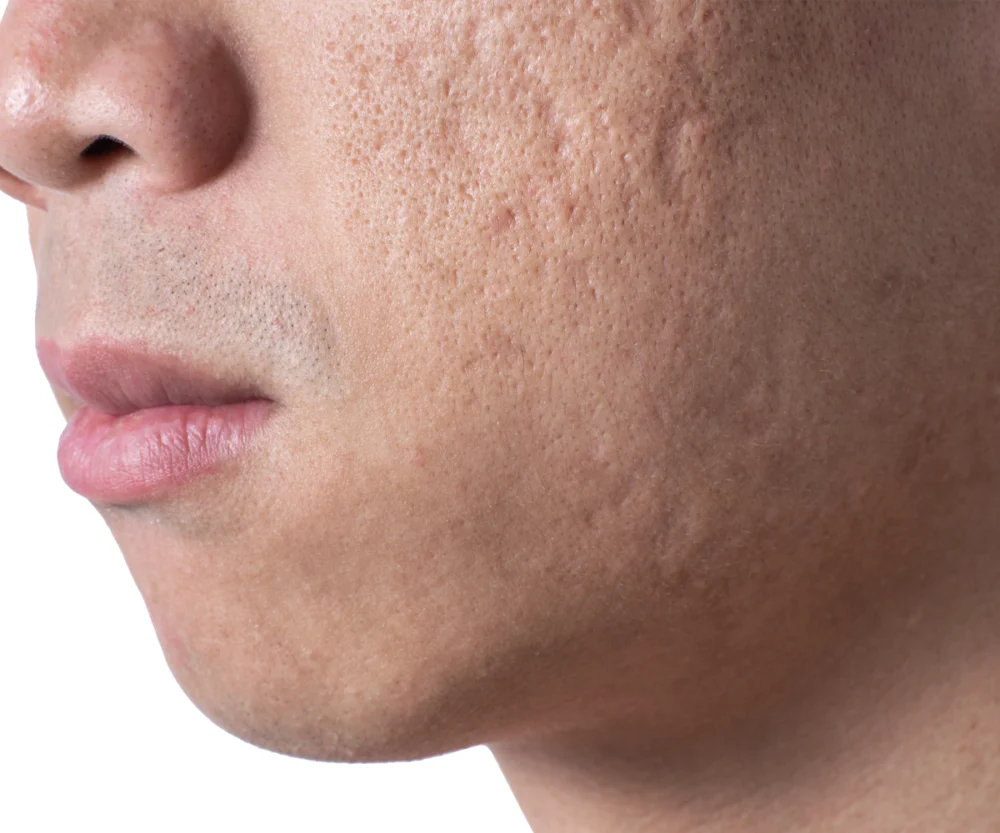
Fillers for acne scars – restore volume beneath indented scars
Acne scars look different and therefore need to be treated differently.
Laser treatment, microneedling and RF microneedling are effective treatments for many types of acne scars, but sometimes the problem runs deeper: there is a lack of tissue and volume beneath the scar itself.
In that case, fillers can be a very effective complement.
At NYOclinic in Gothenburg, we use dermal fillers to to restore local volume in selected atrophic acne scars. If the scar is also embedded in deeper tissue, the treatment can be combined with subcision.

Malin Nilsson
Registered Nurse

Greta Öberg
Registered Nurse
Vill du veta mer, eller boka en tid? Prata med oss
Why do you get pockmarks after acne?
When deep inflammation heals, the skin’s normal structure and supporting tissue may be damaged.
The result could be a atrophic acne scar, that is, a scar that lies below the surrounding skin.
However, not all volume loss is the same.
We usually distinguish between:
Localised loss of volume
Individual scars or pits lack support directly beneath the scar.
A more general loss of volume
A larger area, such as the cheek, has lost volume and support.
This is an important distinction, as the treatments do not necessarily have to be the same.
Which types of acne scars are suitable for fillers?
Fillers are particularly suitable for depressed atrophic scars where there is a clear localised volume defect.
A small amount of filler is then injected directly beneath the scar to provide support and lift the sunken tissue.
It can produce an immediate visible improvement, whilst the tissue continues to stabilise after treatment.
Fillers, however, are not suitable for all types of acne scars.
Very small or narrow scars, such as deep ice-pick scars, are usually treated more effectively using other techniques. Scars that consist primarily of uneven skin texture may also respond better to treatments such as RF microneedling, microneedling or fractional laser therapy.
The right scar – the right treatment is far more important than trying to use the same method all over the face.
Is subcision always necessary before having fillers?
No.
It is a common misconception that all depressed acne scars need to be subcised.
Subcision is particularly relevant for tethered scars – scars that are anchored to the underlying tissue by fibrous strands.
These scars can sometimes be felt or appear more clearly when the face moves. The skin is pulled down and the scar can create a dimple or a crease when facial expressions are made.
In subcision, we insert a needle or cannula beneath the scar and release the fibrous adhesions.
Once the scar has been released, filler may in some cases be injected beneath the area to restore lost volume and provide support for the released tissue.
However, if the scar is not tethered, there is no reason to automatically perform subcision.
Why are subcision and fillers used in combination?
The two treatments address two different problems:
Subcision → releases the attachment.
Fillers → restore lost volume and provide support beneath the scar.
Research into atrophic acne scars has shown that, in some studies, the combination of subcision and hyaluronic acid fillers produces better results than subcision alone.
The filler can also help to maintain the space created by subcision and reduce the tendency for the released scar tissue to be pulled down again during healing.
How long do fillers last in acne scars?
Many people worry that the results will disappear as soon as the filler starts to break down.
In practice, the situation is more nuanced.
Hyaluronic acid fillers are biodegradable and will gradually break down. How long they remain in the body varies depending on the product, the amount used, the injection site and the individual.
However, the treatment of a scar is not solely a question of how long the collagen molecules themselves remain.
Injections, subcision where necessary, and the subsequent healing process can help to tissue remodelling and new collagen formation. Studies on filler treatment for atrophic acne scars show that the improvement can be long-lasting, although results and durability vary between products and patients.
It is therefore not the same situation as, for example, using fillers solely to create cosmetic volume in the lips.
Do we need to top it up?
Sometimes.
We often prefer to start conservatively and allow the tissue to heal before assessing whether further fillers are needed.
After about a month, you can see the results much more clearly.
If there is still a localised volume defect, a small amount of filler can be injected during a follow-up treatment.
With us, you therefore have the opportunity to a reduced price for 0.5 ml of filler when attending a follow-up appointment within the specified time period following the first acne scar treatment.
Localised or generalised loss of volume – an important distinction
Sometimes we see patients whose problem does not actually consist of a number of isolated pits.
Instead, there is a a more diffuse loss of volume, for example across the cheeks, which makes the whole area look more sunken and uneven.
In that case, it is not always the best approach to inject small amounts of filler under each individual scar.
In such cases, we might instead consider a treatment that focuses on a larger area and stimulates tissue and collagen more generally.
This could, for example, involve collagen-stimulating injection treatments based on CaHA, PLLA, PCL or other biostimulative materials.
The most suitable method depends on your skin type, the type of scar, the degree of volume loss and the desired result.
Fillers or a collagen-stimulating treatment?
A simple rule of thumb is:
Occasional localised potholes → filler may be a good option.
Tethered scars → subcision, sometimes combined with dermal fillers.
Diffuse volume loss over a larger area → a collagen-stimulating treatment may be more appropriate.
Very small or deep scars → other scar treatments may be required.
It is also common for a person to have several different types of acne scars at the same time. In such cases, the best treatment plan may involve a combination of different methods.
Can fillers be used in combination with Sylfirm X, Dermapen or a CO₂ laser?
Yes, and in cases of more extensive acne scarring, a combination treatment is often appropriate.
Fillers and subcision are primarily used for volume and deeper anchoring, whilst treatments such as RF microneedling, microneedling and fractional CO₂ laser target other aspects of scarring.
We can therefore, for example, treat deeper localised volume defects with fillers and then continue to address skin texture and minor scarring using an energy-based or microneedling treatment.
The treatments need to be scheduled at appropriate intervals.
How can you tell if a scar is well-established?
A tethered scar is attached to deeper tissue.
When the skin is stretched or the face moves, you can sometimes see that the scar pulls down or forms a crease instead of following the skin’s contours freely.
It is precisely these fibrous adhesions that subcision is designed to release.
This also means that subcision is not automatically the right treatment for every pore or acne scar.
Recovery time following filler and subcision
After treatment, the area may:
- swollen
- tenderly
- red
- bruised
Bruising is relatively common, particularly when we need to work with a needle beneath individual scars or perform subcision.
The swelling is usually temporary.
As with any filler treatment, there are also some less common complications. Injectable treatments should therefore be carried out by medically trained staff with knowledge of facial anatomy and the management of complications.
Which acne scar treatment is right for me?
The most important thing is to first identify why the scar looks the way it does.
One scar may need volume. Another may need to be released using subcision. A third may need skin renewal. And sometimes all three problems are present on the same face.
At NYOclinic, we therefore combine several techniques where necessary, rather than treating all acne scars using the same method.
Brief summary
Localised loss of volume → filler
Anchored/tethered scar → subcision ± filler
Diffuse volume loss → consider collagen-stimulating treatment
Uneven skin texture and minor scarring → for example, RF microneedling, microneedling or fractional laser treatment
How much do fillers for acne scars cost?
Our current prices are:
Subcision + filler 0.5 ml – 3,490 SEK
Subcision + 1 ml of filler – 4,490 SEK
Follow-up filler 0.5 ml – 990 SEK
The reduced monitoring applies during the period specified in the booking.
You can always find the latest prices and terms and conditions on our Bokadirekt website.
Fillers and subcision for acne scars in Gothenburg
At NYOclinic in Gothenburg, we treat acne scars based on the type of scar, its depth, how deeply it is embedded in the skin, and any loss of volume.
For the right type of atrophic acne scar, dermal fillers can provide immediate improvement by restoring the lost structural support beneath the scar. In the case of tethered scars, the treatment can be combined with subcision to first release the scar and then restore volume.
The aim is not to cover the whole face – but to apply the right treatment at the right level and to the right type of scar.
You can find current prices and treatments available for booking via our ‘Book Direct’ service.
