


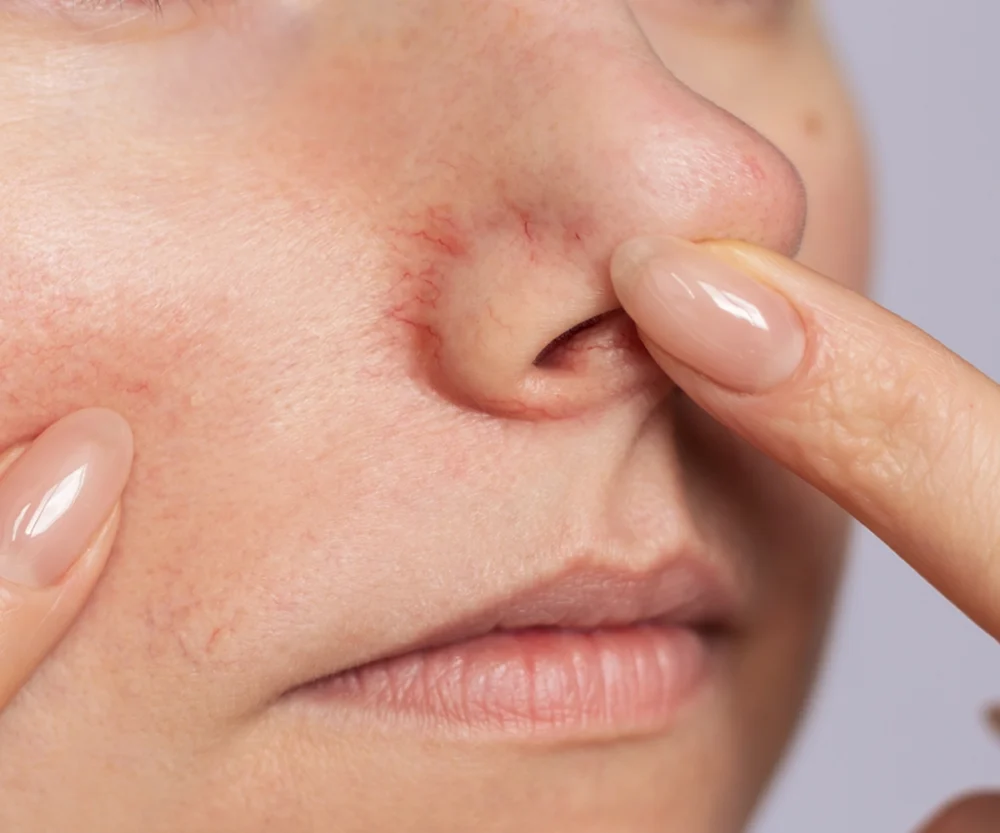
Laser vascular removal (980 nm) – effective treatment of superficial blood vessels
Visible blood vessels on the face or body – often referred to as spider veins or telangiectasias – is a common cosmetic problem. With modern diode lasers (980 nm), these vessels can be treated quickly, precisely and effectively without surgery.
The treatment targets the haemoglobin in the blood directly, causing the blood vessel to clot and be gradually broken down by the body. The result is a clearer complexion and a more even appearance.

Anna Klang
Authorised Dermatologist, Cidesco
Annie Broström
Authorised Dermatologist, Cidesco
Vill du veta mer, eller boka en tid? Prata med oss
What are telangiectasias and spider veins?
- Telangiectasias = small, superficial blood vessels (often on the face, e.g. the nose and cheeks)
- Spider veins = a broader concept, often on the legs or body, sometimes involving deeper vessels
👉 Important: Not all vessels look the same – which is why the right treatment is required.
Which blood vessels can be treated with a laser?
Laser treatment works best on:
- Red, superficial blood vessels
- Blood vessels around the nose and cheeks
- Fine spider veins
- Cherry angioma (red spots)
- Small blood vessels on the body (<3 mm)
💡 Clinical guideline (important for the patient to understand):
- Red vessels = superficial = laser works well
- Blue/purple veins = deeper = sclerotherapy is usually more effective
How does laser vein removal work?
The laser light is selectively absorbed by the blood in the vessel.
This generates controlled heat, which causes the vessel to close and be broken down naturally by the body.
- No surgery
- No needle (for the face)
- Fast processing time
- Minimal downtime
Areas of treatment
Face:
- Nose
- children
- Hook
Body:
- Bones (superficial vessels)
- Other smaller areas
How many treatments are needed?
- Smaller vessels: 1–2 treatments
- More extensive areas: 2–5 treatments
The result depends on the depth of the veins, their colour and your skin type.
After treatment – what can you expect?
- Mild redness and swelling (1–3 days)
- In some cases, small scabs that disappear within a few days
- The vessels gradually fade
Important:
- Avoid the sun
- Use SPF
- Do not touch any scabs
Benefits of laser treatment for blood vessels
- Fast and accurate treatment
- Minimal recovery time
- No surgery
- Immediately visible improvements
- Particularly suitable for the face
Price – laser vein removal
- 1 area (nose, cheeks or chin): 1,500 SEK
- 2 areas: 2,500 SEK
- Body (small veins / spider veins): from 2,000 SEK
👉 For larger or deeper vessels, it is recommended instead that sclerotherapy.
Does it hurt to remove blood vessels with a laser?
Most people experience a slight tingling or warm sensation. The treatment is quick and usually does not require any anaesthetic.
Do the vessels disappear straight after the treatment?
Some vessels disappear immediately, whilst others fade gradually over the weeks following treatment.
Can all types of blood vessels be treated with a laser?
No. Red, superficial blood vessels respond best to laser treatment. Blue or deeper blood vessels are usually treated more effectively with sclerotherapy.
How long does the result last?
Treated blood vessels disappear permanently, but new ones may develop over time depending on genetics, skin type and lifestyle.
Can blood vessels on the face be treated?
Yes, that’s one of the most common areas. Lasers are particularly effective for blood vessels around the nose and cheeks.
Is there a recovery period?
Minimal. You can usually get back to your normal routine straight away, but you may experience some redness for a few days.
When should the treatment not be carried out?
This treatment should be avoided in the following cases:
- Pregnancy
- Active tan
- Certain medical conditions
Is laser treatment better than sclerotherapy?
It depends on the vessels:
Face / red veins → laser
Varicose veins → sclerotherapy
